A Bomb from Praise Rufus: The Rising of a New Dawn

" The cruelty of the global pandemic 
seems limitless. 
So many broken promises, 
broken connections and broken hearts.

In the midst of chaos, 
These difficult times gives us the opportunity to look inward,
reflect on what truly matters, and connect with ourselves and our loved ones on a deeper level.

What lies behind us and what lies ahead of us are tiny matters compared to what lies within us.
Cause the long awaiting dawn is here ".

The Rising of a New Dawn, a digital art by Praise Rufus
Artist: Praise Rufus
Title: The Rising of a New Dawn
Medium: Digital Art
Size: 24 x 36 inches 

Such is the powerful message in this amazing digital art by Praise Rufus. You will no doubt fall in love with, and marvel at this excellent work. The artist has once more demonstrated her creativity and dexterity in the use of any media to pass a message across or express feelings. Here is an artwork the female folks will love to look at everyday! Decked in blue, in what appears to be a cotton sweater, with a blue Gele to match, this beautiful piece invokes admiration and awe at the same time. And who will not love those designs on the clothing and the headgear? The blue colour and the floral patterns are what enhanced the attractiveness of this masterpiece., lest we forget, the facial flower is also there! 
However, the artist seems to have intentionally made the human 'black' complexioned. Dark is used to represent the black race or Africanness, and black as we all know is beautiful. Kudos to Praise Rufus for an amazing creation.  


Beaming the Light on 'Raven's Visit' by Diyen Dan.


A Charcoal pencil drawing by Diyen Dan titled 'Raven's Visit'.
Raven's Visit by Diyen Dan

   Title : Raven's Visit.

   Medium : charcoal on chipboard .

   Size 120cm by 90cm.


Nigerian artist Diyen Dan has once more shown his mastery of charcoal pencils in this skillful piece. Picking his support being Chipboard, his fingers did the magic of bringing to life a lively bird enveloped in a friendly dance with a human that appears to be embattled. While this exciting piece may elicite some feeling of disgust and shun, Diyen Dan in describing this work, posits that "Seeing ravens often signifies that you have a strong, mysterious energy force in your life. They may show up when you feel you need to reflect on your character and your life as a whole . Perhaps your strong energy may influence others in a negative way, so this bird shows up when you need some introspection". Such is the admiration in this work by a gifted artist, whose many pencil renditions leave viewers in awe.

How far with the recurring Lockdown? Find out from Artist Emmanuel Chidubem Okonkwo

Emmanuel Chidubem Okonkwo captured one the problems of the Covid-19 through his 'Lockdown' Mixed Media painting.
'Lockdown' by Emmanuel Chidubem Okonkwo

 In a time when the Corona Virus pandemic is still ravaging the world, it has also brought with it forced starvation and hunger, orchestrated by incessant lockdowns enforced by embattled government seeking to contain the spread and menace of the virus. 

In the midst of all these, Nigerian Visual artist Emmanuel Chidubem Okonkwo came up with an amazingly beautiful piece that captured the helpless situation of people world over as the virus continued to scourge. Standing at 20 by 24 inches, 'Lockdown' depicts what has being happening thus far as a result of the Covid-19 pandemic.The poor young boy in the painting, with a sullen sorrowful eyes, is seen battling with the pang of hunger as he clinches a metal-like bowl soliciting for food. Not knowing what tomorrow holds for him, and being aware of the millions of people the raging virus has cut short their existence, he is seated alone, in observance of the social distancing measure. A more closer look at the lad reveals him donning the traditional nose mask.

This is unarguably a masterpiece from the artist, and he for sure deserve commendation for this historical creation. This piece will stand the test of time as generations unborn will surely know about the Corona virus menace, that respect no gender, status or race.

In an all-over repeat pattern rendition of strokes which flows into each other in similarity and harmony, Emmanuel Okonkwo has served us another delicious dish which we'll always revere. 

When Stephen Daniel Ose's piece enkindle HOPE

The socio-political and economic landscape of Nigeria has being on a recurrent downward movement since after gaining independence in 1960. It has being from one National challenges to another, leaving one with nothing other than hopes hanging in the balance and surrendered fate enmeshed in wasteful daydreaming. 
Stephen Daniel Ose captured and expressed the gory situation in a country that was dubbed the 'giant of Africa, through his work titled 'HOPE'. A remarkable Mixed media artist, his work describes a "Nation divided; a Nation now living with hunger; scared of walking around because of insecurity. When we see a Policeman, herdsman, militant, petty thief, area boy, the first thing we do is to hands up and say don’t shoot. All I just want to say is that there is hope and a future for Nigeria. We need to be better citizens, we need to join hands with our fellow Nigerians, irrespective of region and religion, to bring Nigeria ever closer to the dreams of our Founding Fathers, Many people are losing HOPE, feeling that we are in dark situation but this is not true, because in every situation there is a solution, even when we feel we are in a bad situation, we have to remember that small light can change a situation".

A mixed media painting titled 'Hope' done by Nigerian artist Stephen Daniel
'Hope' by Stephen Daniel Ose 


Such is the beautiful message in this work rendered in Pen and Newspaper prints on paper. This expressive rendition leaves no one in doubt that tomorrow will indeed be great and bright for a country that is a pride to the black race.


How Oloidi exposed link between artists and pre-independence Nationalists

 Prof Ola Oloidi (1944-2020), was an Art historian of great repute at University of Nigeria (UNN), Usukka, Enugu State. His contribution to the enrichment of Africa’s visual culture space will keep enduring. Oloidi died on Monday, November 2, 2020.

Among Oloidi’s many public lectures outside his academia practice was the historic one he delivered at the fourth edition of Yusuf Grillo Pavilion, in April 2012. The event was an edition dedicated to the celebration of Prof Uche Okeke’s art.
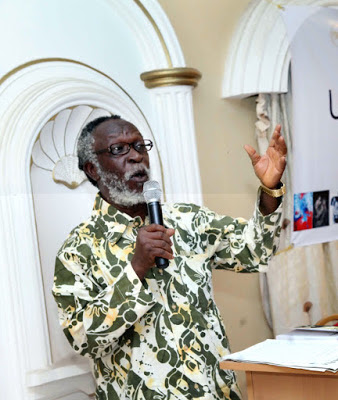
Prof Ola Oloidi, during his lecture at Grillo Pavilion 2012. Pic: c/o Yusuf Grillo Pavilion


In the historic lecture titled 'Uche Okeke: An Endearing Embodiment of Art Revolution in Nigeria', Oloidi recalled that though, Okeke (1933-2015) had imbibed the art philosophy of Akinola Lasekan and Aina Onabolu, there came a sudden and “new ideologically instrumental direction.” Oloidi, a colleague of Okeke at the University of Nigeria noted that the hustle and bustle of political movement by Nigerian nationalists such as Nnamidi Azikiwe, Obafemi Awolowo, Aminu Kano, Anthony Enahoro and Eyo Ita energised the artist's work.

Oloidi disclosed how Okeke explained being “naturally constricted into the invisible army of nationalistic revolution that was targeted at a non-physical war against colonization.”

The art historian stressed that it would have been impossible for the then young and dynamic artist like Okeke not to notice the radical changes taking place around him, particularly when Lasekan, his master, was artistically employing creativity to fuel the burning political tension in the country.

“It was the period the Nigerian political climate began to change with that desire for an all embracing and un-parasitic freedom," Oloidi told guests at the 4th Grillo Pavilion fiesta. "It was an age that Lasekan, also an artist-nationalist, used his cartoons in the West Africa Pilot of Azikiwe, to fight colonialism." Oloidi recalled how Lasekan said, ‘I had to give Zik the political art so as to make him complete his political act’.”

Oloidi argued that it was therefore a natural transition when Okeke, later, as a student at Nigerian College of Art, Science and Technology (now Ahmadu Bello University), Zaria, in 1958 gathered his colleagues to form a group that radicalised art in the country, “which he named Zaria Art Society.”

Prof Oloidi asserted that the group’s pioneer members such as Prince Demas Nwoko, Simon Okeke, Bruce Onobrakpeya and Yusuf Grillo “all embraced Uche’s ideology of ‘natural synthesis’ and helped bring actuality in the society’s well processed objectives.”  Okeke’s ideology, Oloidi noted, was not really popular among the generality of students. However, few students who were not members of the society, like Jimoh Akolo, he said, embraced the ideology too.

He summarized the society’s art ideology thus: “Among other many nationalistic and culturising activities, the members of the Zaria Art Society, or more particularly, the more aggressive Demas Nwoko, Onobrakpeya, Grillo and Simon joined Uche – though in their private period – to start producing art works that were violently instructed in African traditional art formalism. In fact, their ‘anti-academic’ imageries were visually aggressive and technically rebellious.”

Still on Okeke’s radical art, Oloidi argued that the artist’s “modernisation of the traditional Igbo uli body art, is his most creative achievement.”

The art historian noted that Okeke, after his college education, “devoted attention, very fanatically, to the study of uli.”

The Yusuf Grillo Pavilion was launched in 2009 as a resource centre for the promotion of Nigerian art. So far, all the artists celebrated by the Grillo Pavilion are members of the Zaria Art Society otherwise known as ‘Zaria Rebels,’ in Nigerian art parlance.

In 2010, it was Onobrakpeya’s event, and Prof dele jegede delivered the lecture. Last year, a renowned architect, Prof. John Godwin gave the lecture at another Zaria Rebel, Prince Nwoko’s celebration.

Earlier, at the 2012 edition of the Grillo Pavilion fiesta, the founder, Chief Rasheed Gbadamosi (1943-2016) in his welcome address tagged ...As We March On Ceaselessly… noted thate there was a “ferment in arts consciousness” during the late 1950s, “which was parallel to the political emancipation story of Nigeria.” Gbadamosi said the literary thoughts of Okeke “blossomed then and it continued in the wake of the civil war. His restless soul engendered the birth of another school, Ulism, a portrayal of the depth of artistic creativity.”

He argued that aside Lasekan, Okeke also “hobnobbed with expatriates such as J.G.C Allen, Dennis Duerden, T.M Evans of the Nigerian Broadcasting Corporation, and had even met Bernard Fagg, the renowned ethnographer.”

Gbadamosi assured that Grillo Pavilion would continue searching for the “authentic intellectual underpinning of modern art in Nigeria.”

The exhibition of Okeke’s work at the Pavilion was declared open by His Royal Highness, the Obi of Onitsha, Igwe Nnaemeka Achebe.

During the interactive session, Okeke’s colleagues — Nwoko, Onobrakpeya and Akolo shared the experience of their Zaria days. Nwoko said “Uche was a wonderful colleague; with him no dull moment. I am glad we (Onobrakpeya, Grillo, Akolo) are alive today.”

While Akoko admitted that “I used to be on my own, though later shared the society’s ideology,” Onobrakpeya disclosed that he gained from Okeke’s penchant for documentation, adding further that, “I personally gained from Uche’s documentation of Igbo culture, which inspired me to also document Urhobo.” Onobrakpeya recalled how Okeke “would tell me ‘just write and don’t worry about the grammar, somebody else would put it right.” 

For the exhibition, some of the works, according to Gbadamosi, were on loan to Grillo Pavilion. The donors, he disclosed include Prince Yemisi Shyllon “who has allowed us to raid his priceless collection of the exalted works of Okeke.”

You can Read more at Kings Ndubuisi